It’s been a while since we have seen these Dark Lulu Roses in the flower concession. I picked up a dozen of these last Friday when we were grocery shopping.

Very Pretty – click image for larger size.

It’s been a while since we have seen these Dark Lulu Roses in the flower concession. I picked up a dozen of these last Friday when we were grocery shopping.
Very Pretty – click image for larger size.
Despite recent decline in value of most securities on Wall Street, a few well-managed companies manage to stay ahead of the game. Wal Mart (WMT) is one of those companies.
I have a few shares of Wal Mart in my portfolio. I was going to sell it last year when I reallocated my portfolio from growth to more stable equities, but Verna encouraged me to hang on to it.
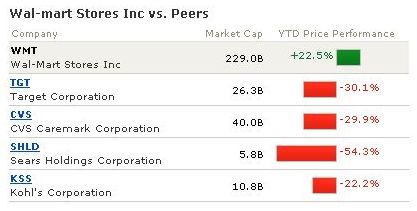
I like her intuition. Twenty-two percent growth in a year is pretty spectacular.
When you look at the lackluster performance of Wal Mart’s peer group, you can see that the retail industry, in general, is not doing too well for a variety of reasons. One of the problems with retailers is labor unions, which drive profits down and operational costs up. Wal Mart, while providing competitive wages and benefits, does not have unions as a factor.
I’m glad for two things: Verna’s intuition, and Wal Mart’s sensible policies on labor.
Yesterday, Verna posted about a pelican.
Today I am posting a photo of another pelican – a Pelican™ Case filled to the brim with our guns. I took this picture Sunday before we went to the range for target practice.

At the left is my two Glocks, in the center is Verna’s S&W revolver and on the right is her S&W and Para Warthog pistols.
Yes it was fun at the range, as ususal.
Pelecanus occidentalis californicus
 Going back through our photos from a few weeks ago, this one of a California Brown Pelican stood out, so I decided to post it here. These birds look so wonderfully graceful in flight, but are sort of awkward-looking as surface creatures (see inset in the photo). Click on the image for the large view of this pelican in flight over the Palos Verdes coastline.
This interesting information on the California Brown is from Sweetwater Authority:
Pelicans are found on coastal salt water, beaches, bays, marshes and on the open ocean, most numerously within a few kilometers of shore throughout the year. At Sweetwater Reservoir, brown pelicans (up to approximately 50 individuals) have been observed regularly from late summer through fall, presumably feeding on the abundant fish population in the reservoir.
Population declines in the 1960s and 1970s were due to the agricultural use of organochlorine pesticides (DDT) which harmed reproduction by causing egg shell thinning and consequential collapse. Since the ban on DDT, the most current threats to the population are pollution, human disturbance of breeding colonies, loss or serious decline of food fishes to human over-fishing, specifically the anchovy, loss of post-breeding roost sites, fishing gear entanglement and bacterial infection resulting from overcrowding at fish disposal areas in harbors.
The pelican was listed as Federally Endangered in 1970, State Endangered in 1971. Monitoring and management activities include protecting nesting colonies from human disturbances in California, annual assessment of reproductive success in southern California populations, preparation of a recovery plan, investigation of the importance of post-breeding areas along the coast of California, Oregon and Washington, disease investigations and studies on the effects of waterfowl shooting on pelicans at the Moss Landing Wildlife Area (Monterey County).
I like to internet surf to the webcams at Catalina Island from time to time. This gives me a current perspective on the weather patterns and island activity. Today, I looked at the webcam at Two Harbors and saw this foggy apparition of Ship Rock looming in the distance.
Some days, though, it is clear enough to see the mainland and even the mountains inland. Roll the cursor over this image to see a clear day from Two Harbors.