Critters

Desert Cottontail

Cottontail Rabbit

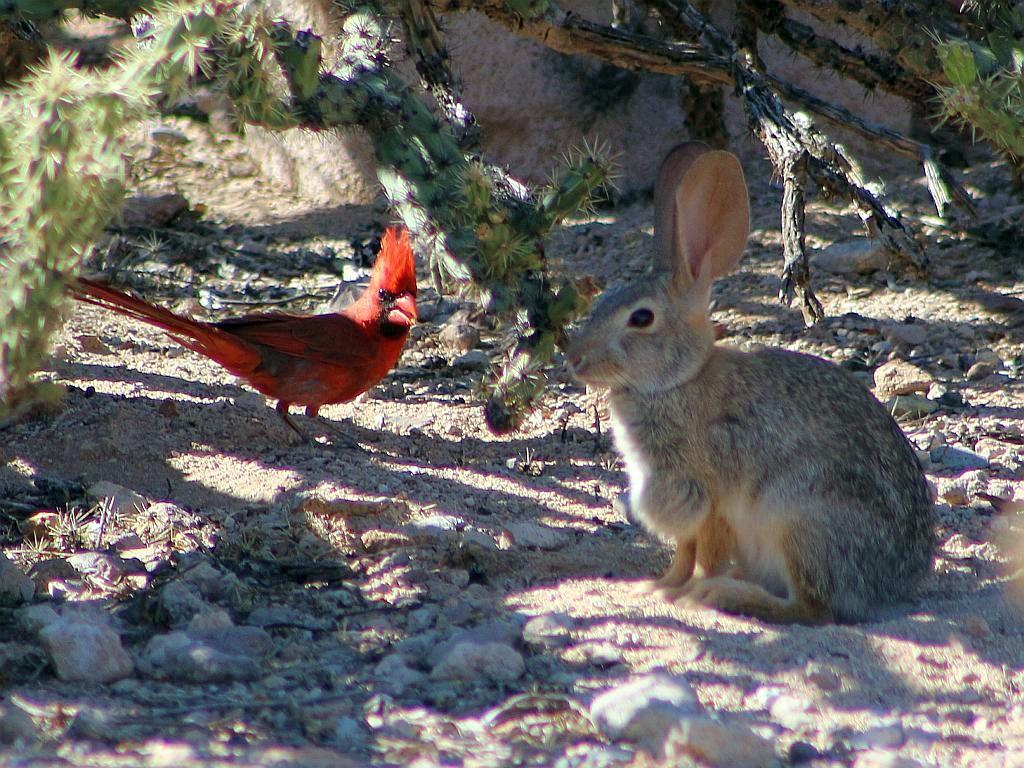
I was in the courtyard late this afternoon and saw one of our little cottontail rabbits browsing in Verna’s rock and cactus garden. I had the Canon SL1 with me and the telephoto lens, so I snapped this quick shot of the bunny as it paused across the driveway: F5.6, ISO 640, 1/400 sec, 300mm and I did some minor post-processing of the image to compensate for the poor lighting conditions. Click on the image to enlarge.

Here is some info about this variety of cottontail rabbit from Wikipedia:

The desert cottontail (Sylvilagus audubonii), also known as Audubon’s cottontail, is a New World cottontail rabbit; a member of the family Leporidae.

The desert cottontail is quite similar in appearance to the European rabbit, though its ears are larger and are more often carried erect. It is also social among its peers, often gathering in small groups to feed. The desert cottontail uses burrows made by rodents rather than making its own. Like all cottontail rabbits, the desert cottontail has a rounded tail with white fur on the underside which is visible as it runs away. It is a light grayish-brown in color, with almost white fur on the belly. Adults are 33 to 43 cm (13 to 17 in) long and weigh up to 1.5 kg (3.3 lb). The ears are 8 to 10 cm (3.1 to 3.9 in) long, and the hind feet are large, about 7.5 cm (3.0 in) in length). There is little sexual dimorphism, but females tend to be larger than the males, but have much smaller home ranges, about 4,000 square metres (1 acre) compared with about 60,000 square metres (15 acres) for a male.

The desert cottontail is not usually active in the middle of the day, but it can be seen in the early morning or late afternoon. It mainly eats grass, but will eat many other plants, herbs, vegetables and even cacti. It rarely needs to drink, getting its water mostly from the plants it eats or from dew. Like most lagomorphs, it is coprophagic, re-ingesting and chewing its own feces: this allows more nutrition to be extracted.

The Curve Billed Thrasher Nest

Nest Caretaker

We peeked in the Curve Billed Thrasher nest in the cholla cactus in front of our courtyard a few days ago and were delighted to see several chicks had hatched. I took this photo of one of the parents tending the nest as it was getting ready to depart to forage for more food for the hatchlings.

There has been a nest in this cactus and little thrashers have hatched every year since we have been here. This year, the nest is almost inaccessible to our camera as it is buried deep within the spiked arms of the cholla.

Lizard Hunter

Lizard Hunter

I already blogged about Cabela’s lizard obsession the other day. Well, today, she was out in the courtyard again and spent considerable time burying herself up to her haunches in the Cleveland sage looking for the little critter.

Once the lizard got flushed from one of the sage bushes, it would then hide under another until Cabela would again dig under the bush and chase the lizard out. This went on for quite a while.

I thought I was capturing the action on video, but I later found out I was using the HD video function incorrectly and merely got some stills of the action. Maybe tomorrow, when Cabela is in a hunting mood, I can re-stage the scenario and get it on video. Click on the image to enlarge.

Why Won’t the Dogs Look at the Camera?

Bay Bay   Cabela and Verna
Lizard

I tried to get the dogs to look towards the camera yesterday when Verna had them both out in the courtyard. The were both too distracted by something that kept their attention away from the camera. After I took the photos, I pointed the camera toward the ground only to see the source of their distraction: a six-inch long brown lizard.

Click on any image to enlarge.

Turkey Buzzard Aloft

Turkey Buzzard Aloft

In the winter time we seldom see any turkey buzzards overhead, since we are on the northern boundary of their range during the colder months. I was out with the camera today taking pictures when I saw this bird flying much lower than normal.

I took a lot of pictures of the buzzard and this one was about the best of the bunch. Click on the image to enlarge.

Turkey Vultures (Cathartes aura) roam over most of the Americas. Excerpt from Wikipedia:

The turkey vulture (Cathartes aura), also known in some North American regions as the turkey buzzard (or just buzzard), and in some areas of the Caribbean as the John crow or carrion crow, is a vulture that is the most widespread of the New World vultures. One of three species in the genus Cathartes of the family Cathartidae, the turkey vulture ranges from southern Canada to the southernmost tip of South America. It inhabits a variety of open and semi-open areas, including subtropical forests, shrublands, pastures, and deserts.

The turkey vulture is a scavenger and feeds almost exclusively on carrion. It finds its food using its keen eyes and sense of smell, flying low enough to detect the gases produced by the beginnings of the process of decay in dead animals. In flight, it uses thermals to move through the air, flapping its wings infrequently. It roosts in large community groups. Lacking a syrinx—the vocal organ of birds—its only vocalizations are grunts or low hisses. It nests in caves, hollow trees, or thickets. Each year it generally raises two chicks, which it feeds by regurgitation. It has very few natural predators. In the United States, the vulture receives legal protection under the Migratory Bird Treaty Act of 1918.