Nerdliness

Solar Photography Practice

spot1472.jpgThe 2012 annular solar eclipse is just two weeks away. We are still scheduled to witness this magnificent event from Page, Arizona, almost exactly on the centerline of the annular eclipse path. The eclipse will occur about an hour before sunset, so the sun will be low in the western sky at the peak of annularity.

I took a minute yesterday afternoon to check the SOHO website for active sunspots and found that large spot 1472 was showing midway between the center and the limb of the sun. I went outside with the SX-40 and the solar adapter to take some practice shots. For the image at the right, I used the filter (of course) 1/1600′ shutter speed and F8.0 aperture with a film speed of 3200. Sunspot 1472 shows up at about 7 o’clock on the solar disk in the image.

I wanted to make sure that my earlier experiments would work when we are in Page on May 20th. I think that using the filter, a very fast film speed, a fast shutter speed and a normal aperture will enable me to capture the lunar/solar images just fine. Now, if the weather will cooperate, we have it made. 😉 Click on the solar image to enlarge.
Camera Casualty

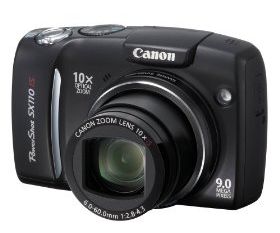
camera.jpgOur recent vacation to visit friends on the Colorado River was great. We both had a lot of fun and enjoyed our friends and their friends company. There was one small glitch when I waded from the riverbank out to a pontoon boat; I totally forgot that my little SX110IS camera was in the cargo compartment of my shorts. The camera was off, of course, but water leaked into the battery compartment, the LCD display and other electro-mechanical stuff.

I didn’t discover the problem until much later in the day. I noticed that the display looked sort of funny with discoloration around the edge. When I tried to turn on the camera it was pretty much DOA. I removed the memory card from the camera and found that all the photos taken before the dunking were still in memory.

Fortunately, I recently purchased another camera, a Canon SX-40; that camera was with us and it won’t fit any pockets I have so I guess it’s safe from the type of screw-up I made with the SX-110.

New Laptop for Verna

new-laptop.jpg

After a couple of years of frustration with her little HP MINI notebook computer, we got a new computer; it is the HP Pavilion G6 notebook. She was handicapped by the lack of video acceleration, caching and memory limitations. That should now all go away.

Her installation is shown in the (clickable) image above. The new laptop, an external 20 inch monitor, external keyboard and mouse. The display is extended to the monitor on the left with the laptop being the master display.

Some of the features:

  • Intel A110 Processor 2.3GHz (3MB Cache)
  • 4GB SDRAM RAM
  • 640GB 5400RPM Hard Drive
  • 15.6-Inch Screen
  • Intel HD Graphics 3000
  • Windows 7 Home Premium 64-bit
  • 5.5 hours Battery Life

Her system is now superior to mine. 😀

Preparing to Photograph the Eclipse

filter.jpgI ordered some solar filters for all of our cameras so we can try to get images of the annular solar eclipse in May. The filters aren’t very substantial since they are made with cardboard tubing and have polymer filters, but they are cost-effective (~$10 each) and they work.

Image: Solar filter over Canon SX-40 with inset of solar photo I took – click to enlarge

The filters come with an adhesive felt liner that you install to allow a snug fit when you slip the filter over the objective lens of the camera. Once installed, the filter doesn’t interfere with the auto-focus mechanisms nor with any other camera function.

After some experimentation, I found that trying to use the cameras in auto modes (other than auto-focus) does not give good results; camera motion would blur most images. I tried using a tripod, but getting the image centered in the camera was taking too long. The eclipse would be over before getting all the proper adjustments.

I finally settled on using the camera in manual mode where you can independently set the film speed, aperture and shutter speed. I settled on ISO 3200 film speed, F5.6 for the aperture and 1/1250 second shutter speed. Holding the camera in my hands, the image was good enough to resolve sunspot 1445 currently transiting the solar surface. I uploaded a large image of the sun to the image viewer. Click on the link to view.

Solar Imaging Experiments

sol.jpgVerna and I are planning an excursion to Northern Arizona in late May to observe the Annular Solar Eclipse on May 20, 2012. We already have reservations to stay in Page, AZ, which is along the centerline of the eclipse path.

Image: The solar disk taken today with my Canon SX110IS camera. Click on the image to enlarge.

I bought several pairs of cardboard eclipse shades for us to be able to safely watch the event. Today, I taped one of the shades to my little camera and took a couple of photos of the solar disk. I took this image while holding the camera in my hands. I expect that image quality will improve by using a tripod. I will be experimenting with both cameras over the next few weeks to ensure that we get some good images when the time comes.

Planetary Conjunction

conjunction.jpg

Planets Jupiter and Venus are currently gathered in the western sky as they do from time to time. This evening, I went out with the new camera on a tripod and played around with some of the settings and modes to get this image of the conjunction in the twilight. I took this image using the AV or “aperture priority” mode on the camera. You can see the two brightest objects are Jupiter (left) and Venus. Our neighbor’s illuminated flagpole is visible near the bottom of the frame. Click on the image to enlarge.