Nerdliness

Devil’s Tongue

Verna took this photo of our Devil’s Tongue barrel cactus in the back yard today. I couldn’t help but notice the patterns of the ribs and spines – they fit in with the mathematical topic of a post I wrote on the other blog about the Fibonacci series called Spiral Seashell. The number of ribs on the cactus and the direction and twists of the spines are all related to Fibonacci numbers. When the blooms come this summer, I’ll try and get a picture of the patterns on the flowers too.

devil-tongue.jpg

Click on the image for a closer look.
Happy PI Day

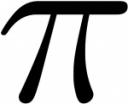
During my career in aerospace and also as a pilot and flight instructor, I have been using the quantity PI (approximately equal to 3.14159265). As explained in the article excerpt below, PI is the ratio of the circumference of a circle to its diameter. Also in the article below is the notion that you can approximate the value of PI by throwing needles or frozen hot dogs.

From SpaceWeather.com

pi.jpgHAPPY PI DAY: March 14th (3.14) is PI day and all around the world mathematicians are celebrating this compelling and mysterious constant of Nature. PI appears in equations describing the orbits of planets, the colors of auroras, the structure of DNA. It’s everywhere.
Humans have been struggling to calculate PI for thousands of years. Divide the circumference of a circle by its diameter; the ratio is PI. Sounds simple, but the devil is in the digits. While the value of PI is finite (a smidgen more than 3), the decimal number is infinitely long:

3.1415926535897932384626433832795
02884197169399375105820974944592307
81640628620899862803482534211706…more

Supercomputers have succeeded in calculating PI to more than 200 billion digits and they’re still crunching. The weirdest way to compute PI: throw needles at a table or frozen hot dogs on the floor. Party time!

I wrote a universal triangle calculator using PI and other constants.

Portuguese Bend Landslide

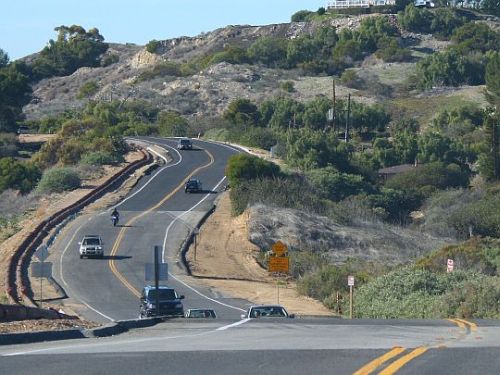
According the the Natural Sciences Department at Cal State University Long Beach, this is a translational landslide. Slides like this move pretty slow. This one, in particular, has moved about 600 feet over the past 50 years. The motion is enough, however, to keep the road builders and line painters busy along this stretch of Palos Verdes Drive South. After a few months movement, however, it looks as it does in this shot taken by Verna last week.

Portuguese Bend landslide

Moon and Mars

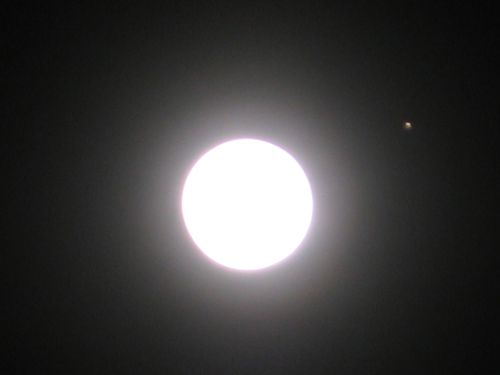
In a rare astronomical encounter, the full moon rose less than 2° away from planet Mars tonight. I took this photo showing the event – I had to overexpose the moon so that Mars would show up. Verna and I looked at this through the binoculars and it was spectacular.

Moon and Mars

Mars

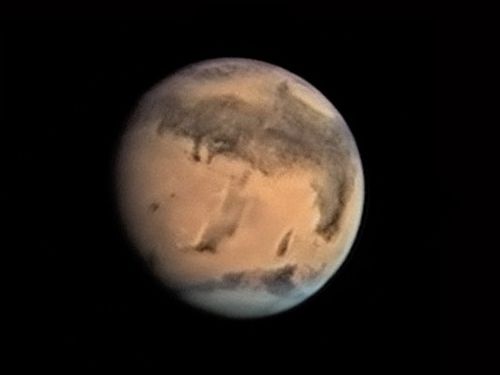
Even though it’s going to be rainy and ugly here for the next couple of days, you might look up at night and see a bright red dot showing through breaks in the clouds. In December, Mars and Earth will pass through the parts of their orbits where the two planets are as close together as they will be this year. Read about the close encounter at Astronomy Picture of the Day.

mars.jpg