Critters

Opossum

I set the small animal trap to try and catch the squirrel that gets in Verna’s garden and raids the bird feeders, but this little ‘possum wandered in much to it’s dismay. Not to worry, though, he got released back into the “urban wild” shortly afterwards.

trapped-possum

Opossums are probably more beneficial than they are destructive in urban areas. Consider this description from the National Opossum Society:

Opossums help to maintain a clean and healthy environment. They eat all types of insects, including cockroaches, crickets, beetles, etcetera. They catch and eat rats, roof rats, mice, and they consume dead animals of all types (carrion). They like over-ripe fruit, berries, and grapes. And they think snails and slugs are a delicacy! Nature’s little Sanitation Engineers!!

Typically they go about their quiet task late at night, and you usually won’t know they were around…unless your dog (being territorial) starts barking, or you happen to take a midnight stroll when one is munching insects or snails in your yard.

Happy Bear

On Sundays, after going to the shooting range, we give Bear a “Frosty Paws” frozen dog treat – it’s like ice cream, but without stuff that might be bad for dogs. When she finishes her treat, she often strikes this relaxed, happy pose.

happy-bear

Back to Standard Time

Now that we’re back on Pacific Standard Time, the sun was setting just after five PM when this bird was heading off into the sunset. I used Verna’s Canon EOS with telephoto lens.

sunset-bird.jpg

Good to the Last Drop

last-dropWhen we spend time outdoors on the weekends, I often enjoy a bottle or two of Sam Adams Lager. After I pour the bottle in the mug, Bear will come up to me, salivating, and looking like she is sooooo parched. So I let her get the last trickles out of the bottle.

Verna snapped this while we were barbecuing out back.

Ruby Meadowhawk Dragonfly

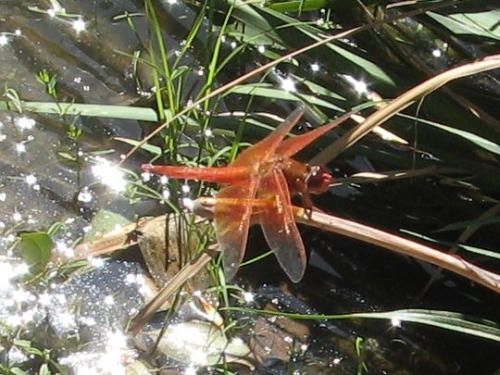
All the years that I have been in California, it was not until last weekend that I saw a red dragonfly. In fact, there were red dragonflies in abundance, around the lake at the South Coast Botanic Gardens. This is one of those infrequent occasions where I got an outstanding picture (Verna is the queen of artistic photos in our family).

ruby-meadowhawk.jpg

I did some research and found out that this is a Ruby Meadowhawk, a variety of the suborder Anistoptera (Dragonfly). This is an excerpt from the WikiPedia page on Dragonflies:

Dragonflies typically eat mosquitoes, midges and other small insects like flies, bees, and butterflies. They are usually found around lakes, ponds, streams, and wetlands because their larvae, known as “nymphs”, are aquatic. Dragonflies do not normally bite or sting humans (though they will bite in order to escape, for example, if grasped by the abdomen); in fact, they are valued as a predator that helps control the populations of harmful insects, such as mosquitoes. It is because of this that dragonflies are sometimes called “mosquito hawks.”

Ladybug

ladybug.jpgLadybugs are small insects, that are commonly yellow, orange, or scarlet with small black spots on their wing covers, with black legs, head and antennae. A very large number of species are mostly or entirely black, gray, or brown, however, and may be difficult for non-entomologists to recognize as coccinellids (and, conversely, there are many small beetles that are easily mistaken as such, like tortoise beetles).

They are considered useful insects as many species feed on aphids or scale insects, which are pests in gardens, agricultural fields, orchards, and similar places. Because they are useful, colourful, and harmless to humans, coccinellids are typically considered appealing even by people who hate most insects, though a few species are pests in North America and Europe. Some people consider seeing them or having them land on one’s body to be a sign of good luck to come, and that killing them means bad luck.

Text above credit to WikiPedia.

I took a picture of this one in the Botanic Garden. Click to enlarge.