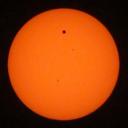
 This image taken yesterday at about 18:24 Arizona time, is the approximate mid point of the transit of Venus. I adjusted the image such that ecliptic north is up. Venus moved from left to right across the northern hemisphere of the solar disc.
Image: Venus at Mid-Transit. Camera: Canon SX-40, Rainbow Symphony Solar Filter, Shutter Speed: 1/2000′, Aperture: F 5.0, Film Speed: ISO 3200. I hand held the camera and did not use a tripod. Click image to enlarge.
We were not able to watch or photograph much more after I took this image, since the terrain at our house rises to the west and apparent sunset is about forty minutes before actual. Regardless, we would not have been able to see Venus exit the disc since that occurred well after sundown here in the 48 contiguous states. We feel lucky that we got to see the midpoint of the transit.
We also feel lucky to have witnessed two solar events in just a little over three weeks, the first semi-rare event being the annular eclipse and this extremely rare Venus transit. The next transit of Venus will be 105 years hence in the year 2117.


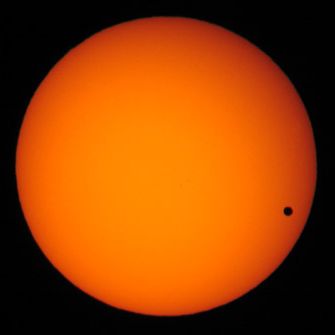 Tomorrow is the rare solar transit of planet Venus. Even though we’re going to be running errands tomorrow afternoon, we’re taking our cameras, solar filters and eclipse shades in an attempt to witness and record the phenomenon. The event starts at a little after three our time and will still be in progress at sundown. We will be home when Venus reaches the halfway point across the solar disc. We will be using the same cameras and techniques used for the