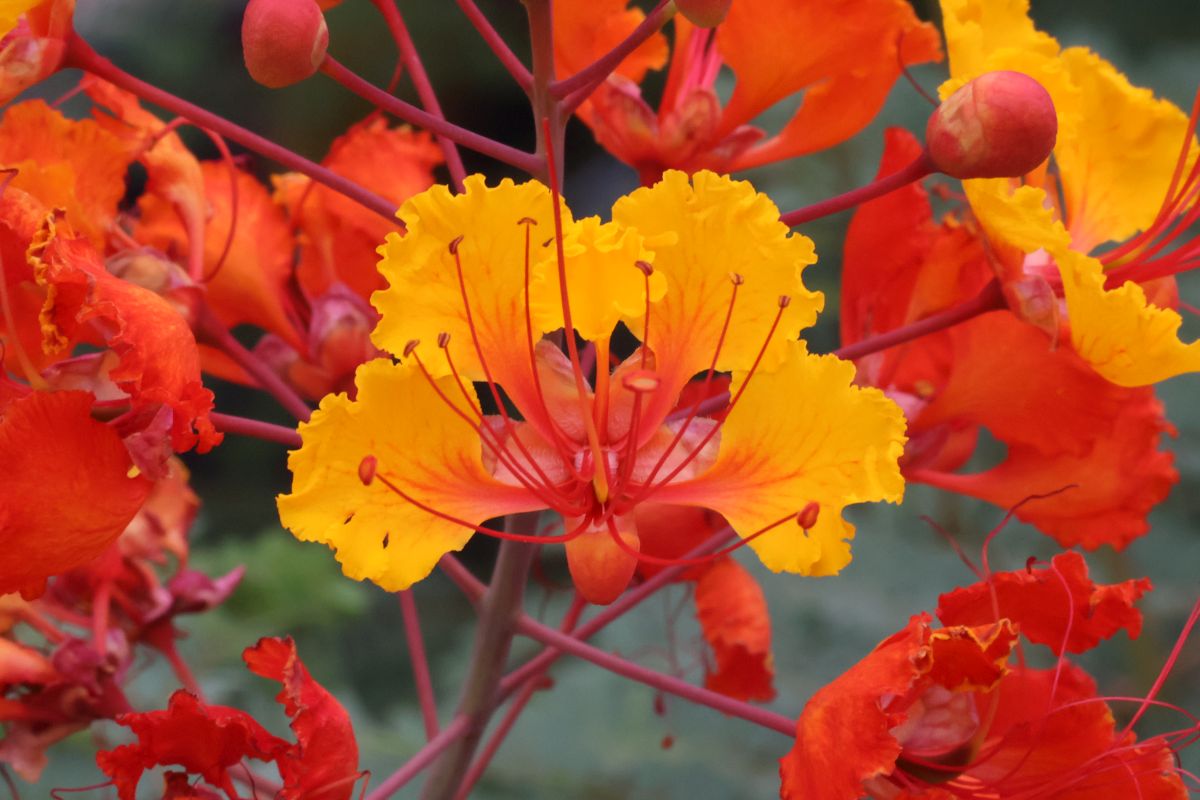
Over the past few months, we noticed that our Red Bird shrubs in the courtyard were looking a little saggy and withered. This month, however, we started getting our seasonal monsoon rains — lo and behold — the shrubs have perked up and flowering like crazy.
The perking up clue led Bob to investigate the irrigation system. For some unknown reason, the station that led to the courtyard was set to “off” rather than a start time for the station to run. Hopefully, that has been corrected now.
Here is some interesting information about our red birds from Gemini:
Caesalpinia pulcherrima—most commonly known as Pride of Barbados, Red Bird of Paradise, Peacock Flower, or Dwarf Poinciana—is one of the most widely cultivated and visually striking flowering shrubs in warm-climate landscapes.
Geographic Origin & Etymology
- Origin: The exact origin of C. pulcherrima is obscured by centuries of human cultivation and trade, but it is broadly native to the tropical and subtropical regions of the Americas. Most botanical evidence points to Central America, Mexico, or the West Indies as its native home.
- Cultural Significance: It is the national flower of Barbados (where it is featured on the Queen’s Personal Barbadian Flag and the national coat of arms).
- Etymology:
- The genus name Caesalpinia honors Andrea Cesalpino (1524–1603), an Italian botanist, physician to Pope Clement VIII, and early plant taxonomist.
- The species epithet pulcherrima is Latin for “most beautiful” (the superlative form of pulcher).
We certainly can agree with the “most beautiful” attribute. Click on the image to enlarge.