Bob
Rock ‘N’ Roll – 50th Anniversary-Mobile
I was looking through some of the many photos that Verna takes and pulled this one out to share. We saw this dude and his eclectic Rock ‘N’ Roll paint job on our way to the shooting range a few weeks ago. I am not able to name all of the faces on the van, but then I am not into that genre of music these days.

Carrion Flower
Verna took this picture of one of my favorite plants. It’s called Stapelia Gigantea and is a cactus-like succulent native to the African continent. I like it, but not because it has pretty flowers, not because of lavish green stalks and certainly not because it smells good.
Every summer, the plant produces several pods that grow like great pointed balloons and then explode into five-pointed, hairy flowers that produce an aroma of rotting flesh. While flowers are in bloom, the flies flock to it and consequently keep out of the patio area. I like that about it – it’s sorta like a fly trap.
That’s Verna’s hand lifting the drooping starfish up to be photographed. The plant can be seen at the left. Click on the image to enlarge.
Here’s more information about this exotic stinker that I lifted from UBC Botanical Garden:
As with many plants, Stapelia gigantea has a suite of common names. These include carrion flower, giant toad flower, Zulu giant, starfish flower and (in Australia) dead horse plant. Most of these are fairly descriptive – it does smell like carrion, it comes from Africa, it’s big, it resembles a starfish and it attracts flies like a dead horse. I haven’t been able to deduce the reason for toad flower, though (perhaps also because of the flies?).
You have probably guessed that this odd plant is pollinated by the blow-flies it attracts.
I should sneak in that Stapelia gigantea is considered an invasive plant in Hawaii and a weed in Australia.
Santa Maria Style Tri Tip
Cooked up on the grill this afternoon. Man, was this good. Verna will be making Marc Antony salads for my lunch this week with the leftovers. I am the luckiest dude on the planet. Click image to enlarge.
According to WikiPedia:
In the United States, this cut was typically used for ground beef or sliced into steaks until the late 1950s, when it became a local specialty in Santa Maria, California, rubbed with salt, pepper, and other seasonings, cooked over red oak wood and roasted whole on a rotisserie, smoked in a pit, grilled, or braised by putting a pot on top of a grill, browning the meat directly on the grill surface before and after the braising. (The tri-tip is still often labeled the “Santa Maria steak”.) Most popular in the Central Coast region of California, it has begun to enjoy increasing popularity elsewhere for its full flavor, lower fat content, and comparatively lower cost.
Military Records
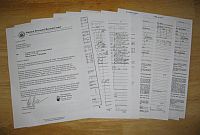
One of the items on my ‘things I need to do before I retire’ list was to obtain a copy of my Military discharge record (DD-214). While I was at it, I asked for the contents of my military personnel record, containing things like training records, performance records, enlistment agreement and so forth.
Right: cover letter and records
The records showed up last week, about six weeks after I sent the fax with my authorizing signature to the records center. I dug through the package – boy, was that a trip down memory lane. Page after page of forms and records documenting my time as a Sailor. Seeing my (immature 17 year-old) signature on the enlistment papers brought back that moment in time when I sat in the recruiting office and signed.
I was in the U.S. Navy (Naval Reserve, to be exact) for six years, three of those on active duty. I signed up when Eisenhower was in the oval office and mustered out when LBJ was busily ramping up the war in Vietnam.
I never regretted my military service to the country. My career benefited from military training in electronics and aviation plus the G.I Bill paid for much of my education. I have never had a problem finding employment, often working two jobs simultaneously (when I was much younger and ambitious).
If you’re a veteran or the immediate survivor of a veteran you can order these records online at The National Archives eVetRecs website. Ordering them is fairly simple; you will need to sign a form they email to you and fax it to them.