Bob

Kingman Locomotive

This beauty is a 4-8-4 steam engine locomotive, popularly used along the main railroads criss-crossing the nation in the late 19th and early 20th centuries. We stopped in the Old Historic Route 66 section of Kingman, AZ, today and spent some time enjoying the nostalgia. Click on the image below for a larger version.

kingman-locomotive.jpg

Winter Cruise

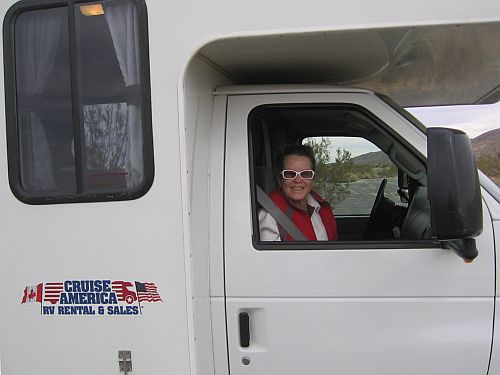
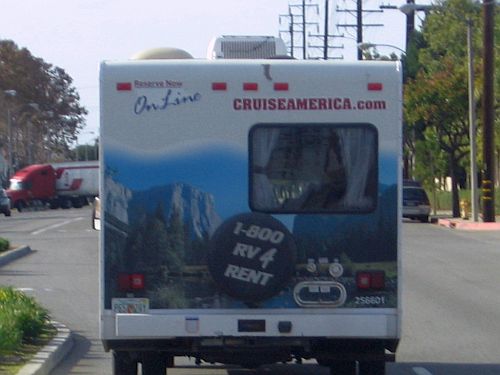
Verna drove the cruiser home from the RV rental yard. At home we put the GMC in the garage, grabbed the dog and took off for Twentynine Palms, California, where we are tonight. Tomorrow we will tour Joshua Tree National Park before heading over to Arizona.

cruiser.jpg

Winter Solstice

Today is Solstice, the shortest day in the Northern Hemisphere – according to the solar ephemeris for our location, the length of our day will be approximately nine hours and fifty-four minutes.

Solar Ephemerides for
Sunday, December 21, 2008
Torrance, California:

Twilight Begins:

05:55

Sunrise:

06:54

Transit:

11:51

Sunset:

16:48

Twilight Ends:

17:47

Total Daylight (H:M):

09:54
The table at the left shows the various events associated with the motion of the Earth at our longitude and latitude. Twilight is the time when first light from the sun begins to illuminate the atmospheric particles or when last light ceases illumination. Sunrise and sunset are the times when the limb (edge) of the sun peeks above or disappears below the horizon. Transit is when the sun midpoint crosses the meridian, or longitude of our location.

The graphic below is taken from a very interesting website, Archaeoastronomy.com. On their website, you can learn about Equinoxes, Solstices and Cross Quarters which are moments shared planet-wide, defined by the earth’s tilt and the sun’s position on The Ecliptic along 45° arcs.

This neat graphic is put into motion on Archaeoastronomy.com.
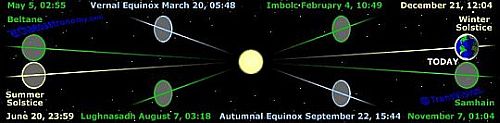
Solstice

Cooking While Cruising

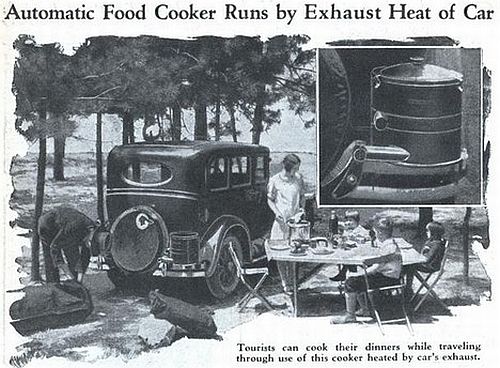
I found this picture on the internet when Verna asked me if we would be able to cook while we’re traveling down the road in a rented motorhome. I was looking to see if there were any gadgets that we could use to heat meals, á lá crockpot-style.

cooker.jpg

I couldn’t find anything that would be suitable for our needs and I would be afraid of carbon-monoxide poisoning with a device like this one, even if they were available today. I guess we’ll have to settle for cooking on the stovetop and in the microwave when parked.

The Mount Wilson Tower Cam

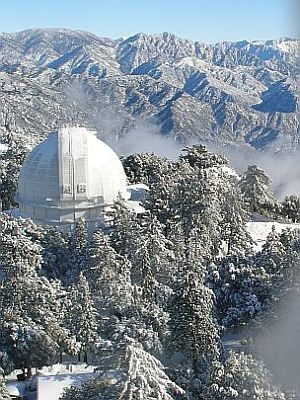
Mount Wilson Weather CameraOne way to keep track of the weather is to find webcams near the area in which you’re interested. Today, after the storm passed through, I took a look at the webcam on the Mount Wilson Solar Observation Tower. I saw this snowy fairyland and the observatory dome housing the famous Hooker 100 inch Newtonian Telescope at the left.

Here’s some history on the Hooker Telescope from the Mount Wilson Observatory:

The Hooker 100-inch telescope is named after John D. Hooker, who provided the funds for the giant mirror. It was the largest telescope in the world from 1917 to 1948 when the 200-inch telescope was built on Palomar Mountain 90 miles to the southeast. Many great discoveries were made with the 100-inch telescope Edwin Hubble’s refinement of the distance scale of the universe. The first optical interferometer ever used for astronomical research was used on the 100-inch telescope to measure the sizes of distant stars for the first time in 1919.

The 100-inch telescope has three optical configurations available to meet the requirements of a wide variety research projects. A very high-resolution spectrograph is located at the telescope’s Coudé focus. Located on the ground floor of the 100-inch telescope dome, the Aluminizing Room is used to recoat all of the telescope mirrors at the observatory.