Over the past several days, it has been quite foggy. Over the weekend, it seemed to stay foggy all day long. I snapped this picture of the sun through dense fog. It was its only appearance the entire day. “They” tell me that it will be clear and warmer for Thanksgiving and the weekend to come. Fine with me. Click on the picture to enlarge.
Leisure
Point Fermin Lighthouse
 It was with good foresight that we decided to archive our photo files on an external hi-capacity hard drive. The dual computer crash last week could have been a greater loss than we actually experienced. While looking at some of Verna’s old photos, I ran across this shot of the historic Point Fermin Lighthouse in San Pedro, California. Click on the image to enlarge.
Here’s some of the lighthouse’s history from the Point Fermin Lighthouse website:
Built in 1874, the Point Fermin Lighthouse was the first navigational light into the San Pedro Bay. Phineas Banning, with the support of many local businessmen, petitioned the Federal Government and the US lighthouse Board to place a lighthouse on the point in 1854. Although the Lighthouse Board agreed funding and land disputes delayed its construction until 1874.
Paul J. Pelz, a draftsman for the US Lighthouse Board, designed the Stick Style Victorian lighthouse. The design was used for six lighthouses built between 1873 and 1874, of which three are still standing, East Brothers in San Francisco Bay, Hereford Light in New Jersey, and Point Fermin. The Stick Style is an early Victorian architectural style and is simpler in design and decoration than the later high Victorian period. It is characterized by its gabled roofs, horizontal siding, decorative cross beams and hand carved porch railings.
If you’re nerdy enough to have a pair of 3D red-blue or red-cyan glasses (like me), then you might enjoy this 3D anaglyph photo I took of the lighthouse at about the same time.
For more 3D images, see Bob’s 3D Stuff in the sidebar.
Jambalaya for Lunch Today
 Lucky me! I get to have this delicious Jambalaya for lunch today. It’s a Cajun dish with chunks of chicken, hot Louisiana sausage (Andouille), medium shrimp, carrots, celery, onions and garlic in a beef and tomato sauce served over a mound of rice. Excellent stuff.
This helping is left over from our dinner last Sunday. Verna snapped this photo as we were sitting down on the patio to eat. Click for the big picture.
Good to the Last Drop
 When we spend time outdoors on the weekends, I often enjoy a bottle or two of Sam Adams Lager. After I pour the bottle in the mug, Bear will come up to me, salivating, and looking like she is sooooo parched. So I let her get the last trickles out of the bottle.
Verna snapped this while we were barbecuing out back.
Primordial Swamp
 Last summer when we visited the Petrified Forest, we saw an artist’s conception of the primordial swamp that existed over 225 million years ago in this now high desert plateau. The petrified and fragmented remains of those ancient trees can be seen throughout a large part of the park.
When we went to the Botanic Garden’s lake area last Saturday, I took this picture of what looked like that swamp picture. The only thing missing is supercrocs in the lake, oviraptor dinosaurs scurrying about and pterodons soaring overhead. Click the image to see the big picture.
Ruby Meadowhawk Dragonfly
All the years that I have been in California, it was not until last weekend that I saw a red dragonfly. In fact, there were red dragonflies in abundance, around the lake at the South Coast Botanic Gardens. This is one of those infrequent occasions where I got an outstanding picture (Verna is the queen of artistic photos in our family).
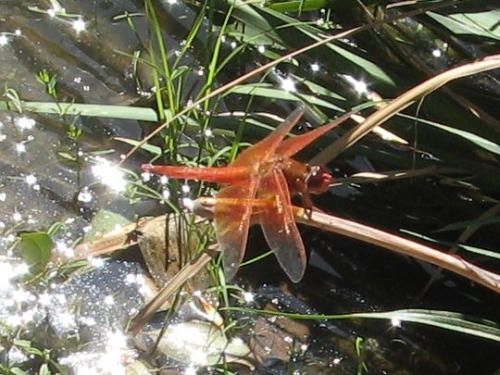
I did some research and found out that this is a Ruby Meadowhawk, a variety of the suborder Anistoptera (Dragonfly). This is an excerpt from the WikiPedia page on Dragonflies:
Dragonflies typically eat mosquitoes, midges and other small insects like flies, bees, and butterflies. They are usually found around lakes, ponds, streams, and wetlands because their larvae, known as “nymphs”, are aquatic. Dragonflies do not normally bite or sting humans (though they will bite in order to escape, for example, if grasped by the abdomen); in fact, they are valued as a predator that helps control the populations of harmful insects, such as mosquitoes. It is because of this that dragonflies are sometimes called “mosquito hawks.”