Today, we were experiencing more Global Warming here in Flagstaff. We’re currently in an RV Park near US 89 and I-40. Snow everywhere. Bear loved it.
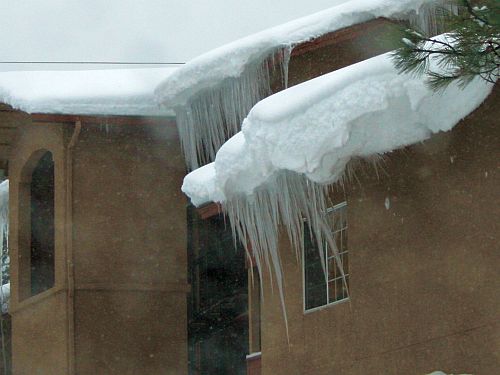
Icicles as long as I am tall.

Today, we were experiencing more Global Warming here in Flagstaff. We’re currently in an RV Park near US 89 and I-40. Snow everywhere. Bear loved it.
Icicles as long as I am tall.
On today’s list of stuff to do, we find celebrating Verna’s birthday in Joshua Tree National Park.
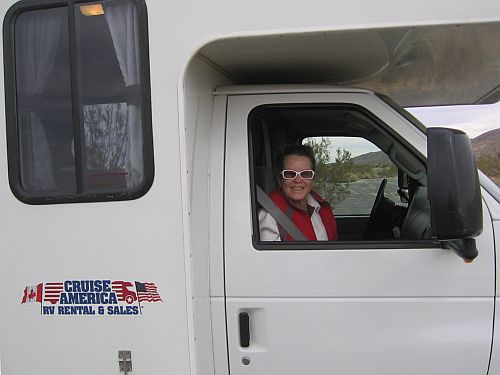
Verna drove the cruiser home from the RV rental yard. At home we put the GMC in the garage, grabbed the dog and took off for Twentynine Palms, California, where we are tonight. Tomorrow we will tour Joshua Tree National Park before heading over to Arizona.
When I planted these poinsettias in the planters by our front porch, I knew that they would be pretty and festive for Christmas. Today, after the rain showers stopped, they looked very pretty indeed, adorned with these glistening raindrops. Click for large size.

Today is Solstice, the shortest day in the Northern Hemisphere – according to the solar ephemeris for our location, the length of our day will be approximately nine hours and fifty-four minutes.
|
The table at the left shows the various events associated with the motion of the Earth at our longitude and latitude. Twilight is the time when first light from the sun begins to illuminate the atmospheric particles or when last light ceases illumination. Sunrise and sunset are the times when the limb (edge) of the sun peeks above or disappears below the horizon. Transit is when the sun midpoint crosses the meridian, or longitude of our location. | ||||||||||||||||
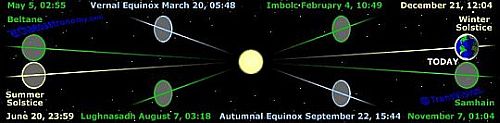
The graphic below is taken from a very interesting website, Archaeoastronomy.com. On their website, you can learn about Equinoxes, Solstices and Cross Quarters which are moments shared planet-wide, defined by the earth’s tilt and the sun’s position on The Ecliptic along 45° arcs.
This neat graphic is put into motion on Archaeoastronomy.com.
I found this picture on the internet when Verna asked me if we would be able to cook while we’re traveling down the road in a rented motorhome. I was looking to see if there were any gadgets that we could use to heat meals, á lá crockpot-style.
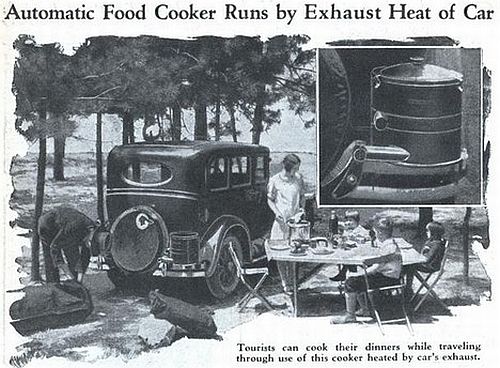
I couldn’t find anything that would be suitable for our needs and I would be afraid of carbon-monoxide poisoning with a device like this one, even if they were available today. I guess we’ll have to settle for cooking on the stovetop and in the microwave when parked.