Bob’s 3D Stuff

Desert Wash in 3D

wash3d.pngI took a pair of photos of the wash that runs in back of and to the west of our house. I combined the pair into this 3D image of the wash and where it crosses the RV drive. I was standing by the back gate of the courtyard when I took the photos.

Image: Our Desert Wash in 3D. Click on the thumbnail image to enlarge.

If you happen to have a pair of 3D glasses, you can see the slope of the wash and drive with respect to the courtyard. When the landscaping crew placed the rocks, they made certain that water flowing down the wash would divert to the road and not into the courtyard.

Of course, you will need 3D glasses to view the red/cyan anaglyph. If you don’t have a pair of 3D glasses, you can view the 2D image here.

Vulture Mine Historical Marker in 3D

This is an accidental 3D image that Verna took of the Vulture Mine Historical Marker near US 60 and Vulture Mine Road in Wickenburg, AZ. I say “accidental” because she snapped two images of the same scene as the truck rolled slowly down the road. I took her pair of images and combined them into a red cyan anaglyphic image that can be viewed with a pair of 3D glasses. Click on the image to enlarge.

The Vulture Mine Historical Marker is located about 12 miles north of the actual Vulture Mine itself. The remnants of Vulture City which sprang up in the mine’s heyday are scattered around the mine shaft. There is a souvenir shop in one of the old buildings where you can get your map of the self-guided tour of the area.

Just in case you don’t have your pair of 3D glasses handy, you can see the 2D image here.

Canyonlands National Park – 3D

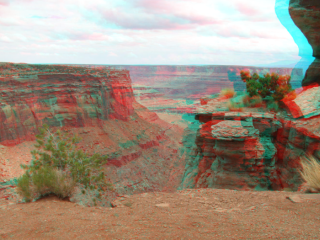
canyonlands-north.pngI was browsing through some of the old vacation photos today, when I discovered an image pair that I took at Canyonlands National Park North back in July of 2008. I never got around to converting the image pair to a 3D anaglyph until today.

Image: A Canyonlands Chasm in 3D – Click on the image to enlarge.

That day, we visited Arches National Park and both the North and South Canyonlands parks in Utah. Verna collected a vial of the red dirt from a roadside outside of the parks. We later used the vial of dirt to specify the exterior color of our Arizona Home,

You will need a pair of red/cyan or red/blue 3D glasses to view the image above. If you don’t have a pair of 3D glasses, you can see the 2D version here.

Roadside Riparian Area in 3D

riparian.pngI haven’t posted one of my nerdy 3D pictures for a while, so here’s one I took today on our shopping trip to the Valley Metroplex.

There is a roadside rest stop a few miles southeast of Wickenburg that is situated along the banks of the Hassayampa River. The area is habitat for riparian wildlife unique to this part of Arizona.

The tree trunk in the foreground is a mesquite, with a variety of other vegetation in the background. We did not see any of the birds or woodland critters today, but this is still a pleasant spot to pull off of US 60 for a rest.

Click on the thumbnail image above to see the full-sized 3D anaglyph. In case you don’t have a pair of red/cyan 3D glasses available, you can see the 2D image here.

Ice Moon Helene in 3D

helene.jpgWhen I surfed over to the Astronomy Picture of the Day this morning, I saw this 3D image of Helene, one of the moons orbiting Saturn.

I grabbed my pair of 3D glasses and saw what this moon would look like if you could see it in stereo. I thought it would be nice to archive it with the 3D stuff and to share it. Of course, if you don’t have a pair of 3D glasses handy, you can view the 2D image here.

This is the technobabble blurb from APOD:

Get out your red/blue glasses and float next to Helene, small, icy moon of Saturn. Appropriately named, Helene is one of four known Trojan moons, so called because it orbits at a Lagrange point. A Lagrange point is a gravitationally stable position near two massive bodies, in this case Saturn and larger moon Dione. In fact, irregularly shaped ( about 36 by 32 by 30 kilometers) Helene orbits at Dione’s leading Lagrange point while brotherly ice moon Polydeuces follows at Dione’s trailing Lagrange point. The sharp stereo anaglyph was constructed from two Cassini images (N00172886, N00172892) captured during the recent close flyby. It shows part of the Saturn-facing hemisphere of Helene mottled with craters and gully-like features.